Ghost Bookings Are Killing Your Revenue — Here's How to Fix Them

Unconfirmed holds blocking your calendar, no-shows eating your occupancy rate. Here is how to eliminate ghost bookings from your venue operation.
Overview
Your boardroom shows as booked all day Tuesday. But at 9am, nobody arrives. At 11am, still nothing. By 2pm you have lost a full day's revenue to a booking that was never real — a hold placed three weeks ago that was never confirmed, never deposited, and never cancelled. That is a ghost booking. And it is costing you more than you think.
Ghost bookings are the silent revenue leak that most venue managers do not measure — because they are invisible on the P&L. They do not show up as a lost sale. They show up as an unexplainably low occupancy rate, an empty room that should have been earning, and a calendar that lies.
This article defines the problem precisely, quantifies the cost, and gives you five specific, implementable fixes — most of which can be automated with the right booking platform.
of meeting room capacity lost to ghost bookings in manually-managed venues
annual ghost booking cost at 1 lost half-day per week × £150 avg half-day rate
reduction in ghost bookings with automated deposit requirements and auto-release
Source: Book a Space platform data, 2026
What Exactly Is a Ghost Booking?
A ghost booking is a calendar hold with no real commitment behind it. It happens when:
- A customer phones to hold a room "tentatively" — and the room is blocked manually without a deposit
- An email enquiry receives a "I will hold that for you" reply — and the hold is never followed up
- A booking is made online but payment is not collected at the time of reservation
- A confirmed booking is cancelled but not removed from the physical booking diary
In each case, the room appears unavailable. Other customers are turned away or go to a competitor. But on the day, the space sits empty.
The Five Fixes
Require a deposit at the point of booking — not on arrival
This is the single most effective fix. An undeposited booking is a soft commitment. A deposited booking is a hard one. Requiring even a 25% deposit at the moment of confirmation transforms the psychological dynamic — and eliminates the majority of ghost bookings in a single step.
Implement auto-release rules for unconfirmed holds
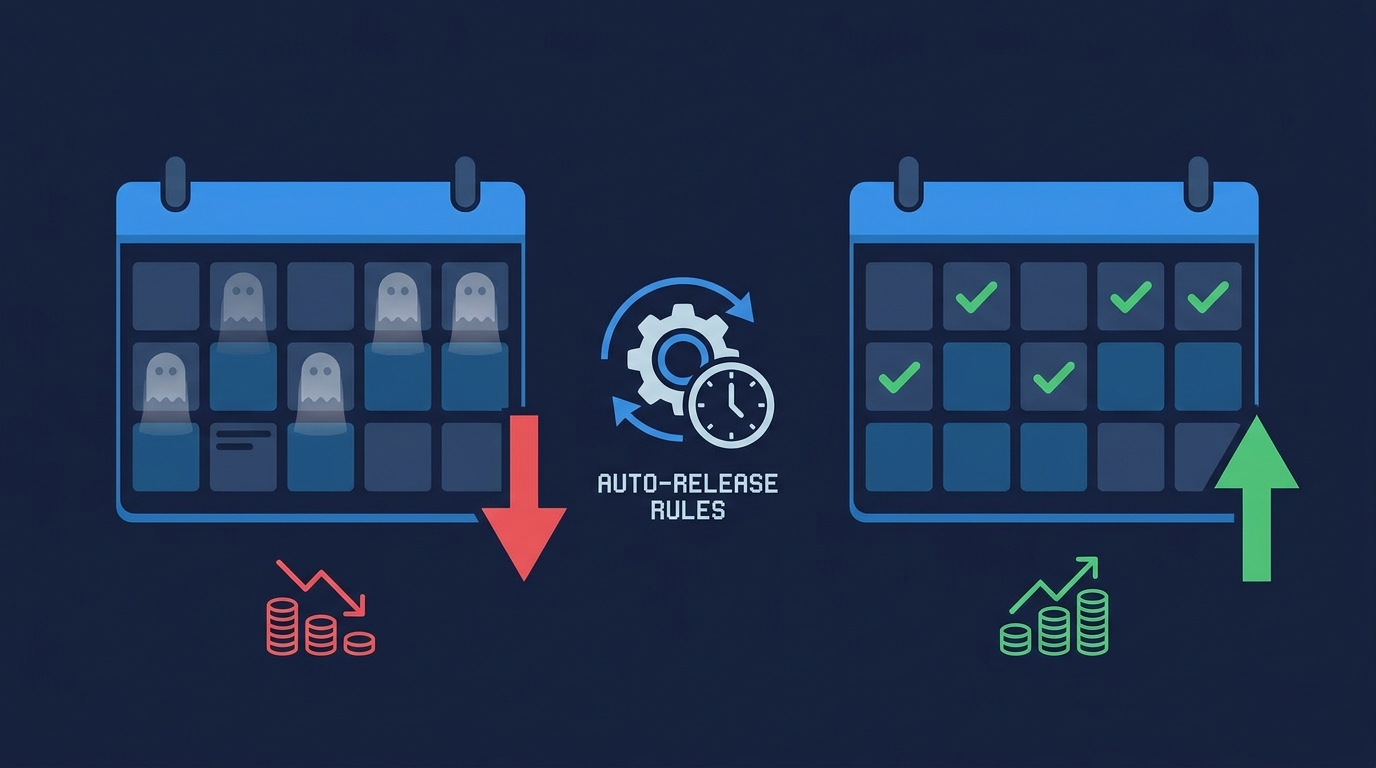
Set a maximum hold window — typically 24–48 hours for meeting rooms, up to 72 hours for large event spaces. Any hold not secured with a deposit within that window is automatically released back into available inventory. No manual follow-up. No human intervention required.
Send automated hold-expiry reminders
Pair auto-release with a "your hold expires in 12 hours" email. This recovers a significant proportion of genuine bookers who simply forgot to confirm — while letting non-committal holds lapse naturally. Conversion rate on these reminder emails is typically very high.
Send pre-arrival reminders for confirmed bookings
For confirmed, deposited bookings, a 48-hour reminder reduces no-shows by giving customers a low-friction opportunity to cancel if plans have changed — in time for you to rebook the space. Include parking details, WiFi, check-in instructions, and a contact number to reduce day-of queries.
Enforce non-refundable deposit policies for peak slots
For your highest-demand time slots — Friday mornings, end-of-quarter dates, holiday-adjacent periods — a non-refundable deposit policy removes the risk of a last-minute cancellation leaving your premium slot empty. Customers who commit to non-refundable terms show up.
The Compounding Effect
These five fixes do not just work individually — they compound. Deposits reduce ghost bookings at source. Auto-release recovers unconfirmed holds automatically. Expiry reminders convert borderline enquiries. Pre-arrival reminders prevent confirmed no-shows. Non-refundable policies protect peak revenue.
Together, they create a booking operation where every slot on your calendar represents a real, committed customer — and every empty slot is genuinely available for the next enquiry.
With Book a Space, all five of these fixes are built into the platform and operate automatically from day one. There is no manual process to maintain, no staff time required, and no ghost bookings slipping through.
See Book a Space in action
Book a 20-minute demo and see how teams cut admin time and grow revenue.
Book a demoFrequently Asked Questions
A ghost booking is an unconfirmed hold that blocks your calendar without a deposit or confirmed payment. The space appears unavailable to other customers, but the original enquirer has no real commitment to show up — leading to empty rooms and lost revenue.
The most effective solution is requiring a deposit at the point of booking, combined with an auto-release policy for unconfirmed holds. Book a Space enforces both automatically — no manual follow-up required.
A ghost booking is a hold never confirmed or deposited. A no-show is a confirmed, paid booking where the customer does not arrive. Ghost bookings are solved by deposit requirements and auto-release; no-shows are reduced by pre-arrival reminders and non-refundable deposit policies.
Even 25–30% significantly reduces no-show rates. For premium spaces or large events, 50% is common. The key is requiring payment at confirmation — not on arrival. Book a Space lets you configure different deposit percentages per space type.
Yes. A 48-hour reminder email significantly reduces no-shows — genuine bookers are reminded and show up, customers who have changed plans cancel in time for you to rebook. Book a Space automates this entire reminder sequence.
Ready to get started?
Join hundreds of venues and workspaces growing with Book a Space.
Book a demo